
Following the recent Committee meeting in June, the Society of British Dental Nurses (The Society) has approved the infographic to help keep the subject of ‘Sexual Misconduct in the Workplace’ on the agenda. Many of you will recall the extensive work undertaken to date by the Society in this field, taking a lead in this area as a direct result of the Royal College of Surgeons’ call to action. Our work has taken the Society to a number of meetings and events to share the findings of our surveys and the lived experiences of dental nurses. The work was such a success that we were asked to open the surveys up to the whole dental team.
Just when you think that we must have moved on, it becomes very clear that sexual misconduct is not a thing of the past, but something that appears to still be an enormous problem across the whole profession. It is so easy to blame the proximity of dental professionals when working with patients, or to look to hierarchy and power-based relationships, but this perhaps just masks much deeper-rooted problems within the profession and a need for a cultural shift, starting with those who have the ability to make changes. The Society has worked with the General Dental Council (GDC) on this matter and has been delighted with their response to date, and to see that someone in the GDC has an interest in this field of work since our work began. We do, however, continue to call on the GDC to follow the approach of the General Medical Council and make amendments to the Standards for Dental Professionals, enabling individuals to quote or reference this, and if they experience such behaviours, feel that they will be supported.
Speaking up about Sexual Misconduct in the Workplace goes beyond the ‘speaking up’ work; it requires different responses and specialised actions, and it certainly should not be just a policy for the sake of being a policy. Anyone writing or being responsible for such a policy quite simply needs to know how to ‘DO’ policy. The Society has spoken about this at a number of key Dental Shows, at stakeholder meetings and for other organisations.
Our Executive Director (Fiona Ellwood) said,
“We must remember that whilst the highest number of reports of sexual misconduct at work are by women
citing men as perpetrators, our survey shows that men report cases of sexual misconduct by women and
that the LGBTQ+ Community are often targeted. We also know that this is not just about professionals v
professionals and/or students of the profession, as we had reports of patients behaving inappropriately
With members of the dental team, and this is not ok on any level.”
Fiona restated a point made at one of the meetings: men are predominantly cited as perpetrators, but not all men are perpetrators, and we do need to be mindful of this when we speak, write, or make assumptions. Men are less likely to speak up, and if they did, would the statistics be higher?
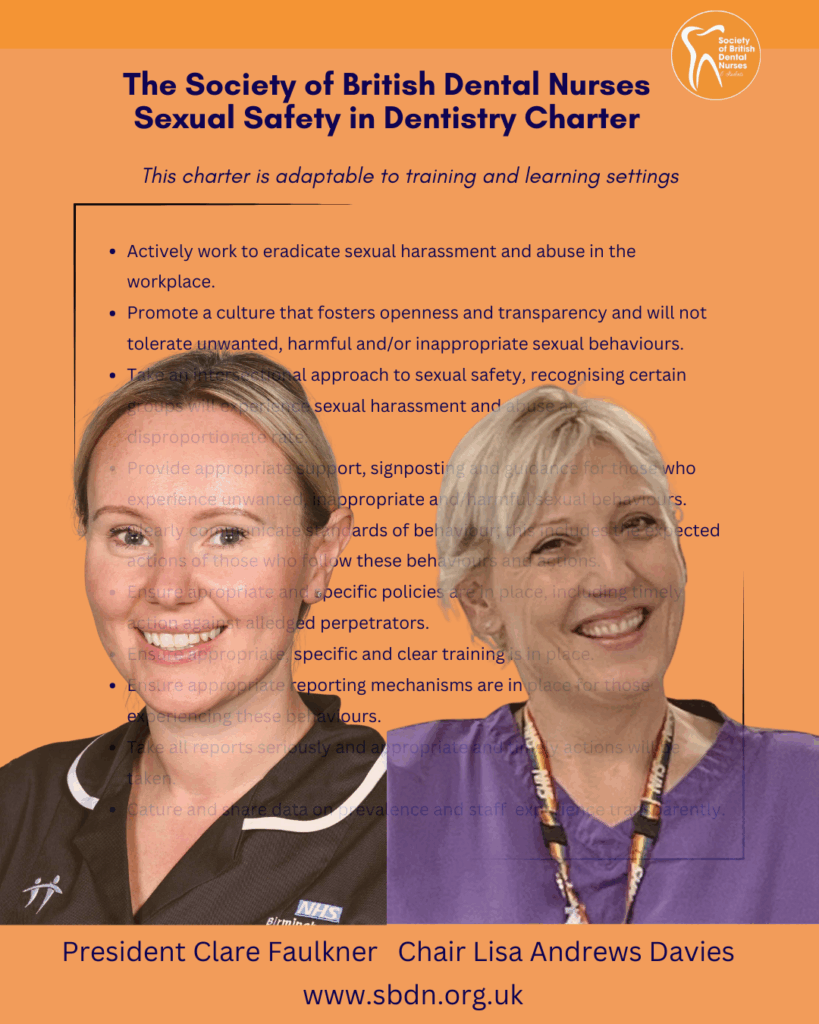
We are delighted that the Dental Professional Alliance now supports this work and we will continue to raise awareness and promote our Charter.
Prevention is now a priority since the new guidelines came into play and employers have a high level of responsibility and accountability.